

Building a Culture of Continuous Quality Improvement (CQI) in Head Start
Strategies for Ongoing Monitoring and Program Success
Continuous Quality Improvement (CQI) is one of the cornerstones of successful Head Start program management. Through ongoing monitoring, data-driven decision-making, staff coaching, and intentional planning, agencies can strengthen compliance, improve service delivery, and create better outcomes for children and families.
Whether you're preparing for federal monitoring, reviewing enrollment processes, or building stronger internal systems, developing a culture of continuous quality improvement helps ensure your program is always moving forward.
Continuous Quality Improvement (CQI) isn't just a best practice in Head Start—it's an expectation.
The Head Start Program Performance Standards require every program to implement ongoing monitoring and continuous improvement to ensure child safety, achieve program goals, and deliver high-quality services. In fact, 45 CFR §1302.100 states that programs must have "a process of ongoing monitoring and continuous improvement" that supports effective, high-quality program services.
Unfortunately, many agencies think about quality improvement only during federal reviews or annual self-assessments.
The most successful agencies take a different approach.
They build quality into everything they do—every day.
In This Article
What is Continuous Quality Improvement?
Why Ongoing Monitoring Matters
Using Data to Drive Improvement
Coaching as a Quality Improvement Strategy
Intentional Planning
How GoEngage Supports Continuous Quality Improvement
The Continuous Quality Improvement Cycle
Download the Free CQI Planning Worksheet
Frequently Asked Questions
Additional Office of Head Start Resources
Continuous Improvement Is a Mindset, Not an Event
According to the Office of Head Start, ongoing monitoring and continuous improvement should be woven throughout every aspect of program operations. The data collected through ongoing monitoring helps programs measure performance, identify concerns early, make timely corrections, and inform annual self-assessments.
That means CQI isn't something that happens once a year. It's something that happens every day.
High-performing agencies continually ask questions like:
How can we improve this process?
Where are we seeing recurring issues?
What trends are emerging?
How can we better support our staff?
Those questions create a culture where improvement becomes part of the organization's DNA.
Data Should Drive Every Improvement
One of the biggest themes throughout the Head Start Program Performance Standards is the importance of using data to make informed decisions.
Section 1302.102 requires programs to collect, analyze, and use data to:
Identify program strengths
Identify areas needing improvement
Correct compliance issues quickly
Prevent recurring problems
Measure progress toward program goals
Support continuous improvement across all service areas
This is where many agencies struggle. Collecting data isn't the difficult part. Turning that data into meaningful action is.
Continuous Improvement Happens During Everyday Work
Many people think quality improvement begins with self-assessment.
In reality, it starts with everyday activities like:
Reviewing enrollment applications
Monitoring attendance trends
Following up on health requirements
Reviewing PIR data throughout the year
Evaluating family engagement
Monitoring disabilities timelines
Reviewing classroom documentation
Coaching staff after file reviews
Each activity provides valuable information that can strengthen the entire program.
Rather than waiting until the end of the year to identify concerns, agencies can make small improvements throughout the year. Those small improvements often have the greatest long-term impact.
Coaching Is One of the Most Powerful Quality Improvement Tools
Quality improvement isn't about finding mistakes. It's about helping people grow.
When supervisors review files, applications, or documentation, every correction becomes an opportunity to coach staff—not simply fix an issue.
Questions such as:
Why did this happen?
What process contributed to the error?
How can we prevent it next time?
help transform quality reviews into professional development.
Over time, coaching creates more consistent practices, stronger documentation, and greater staff confidence.
Intentional Planning Leads to Better Outcomes
The Office of Head Start emphasizes that quality improvement should be intentional.
Rather than reacting to problems, agencies should use data to proactively improve systems, strengthen services, and better meet the needs of children and families. Intentional planning connects data, goals, monitoring, and improvement into one continuous cycle.
When agencies intentionally plan for improvement, they move from asking:
"Did we meet the requirement?"
to asking:
"How can we make this process even better?"
That shift in mindset creates lasting organizational growth.
How GoEngage Supports Continuous Quality Improvement
Technology should do more than store information. It should help agencies improve.
GoEngage was designed to support continuous quality improvement by helping agencies move from reactive compliance to proactive program management.
IMPROVE VISIBILITY
Real-Time Dashboards
Rather than waiting until the end of the month or program year, leadership can monitor program performance as work is happening, allowing them to identify trends and respond sooner.
Reporting & Analytics
GoEngage provides leadership with the information they need to identify patterns, monitor progress, and make data-informed decisions throughout the year—not just during monitoring season.
STANDARDIZE PROCESSES
Application Quality Reviews
Standardized review processes help ensure applications are complete, accurate, and compliant before enrollment decisions are made.
AIR Notes
Document internal reviews, findings, action plans, and follow-up activities in one place. AIR Notes help agencies track progress and demonstrate Continuous Quality Improvement throughout the year.
Alerts & Notifications
Automated reminders help staff stay ahead of deadlines and reduce the likelihood of missing required documentation or follow-up activities.
SUPPORT STAFF GROWTH
Staff Collaboration
Instead of coaching conversations getting lost in emails or handwritten notes, Staff Collaboration allows reviewers and supervisors to document feedback, answer questions, and coach staff directly within the context of the work being reviewed.
This creates a documented history of learning while supporting accountability, consistency, and professional growth.
Coaching Caseload
Take professional development a step further by providing a centralized place to document individualized coaching efforts for each staff member.
By keeping coaching documentation organized in one place, agencies can provide more intentional support, monitor progress toward professional development goals, and demonstrate their commitment to Continuous Quality Improvement.
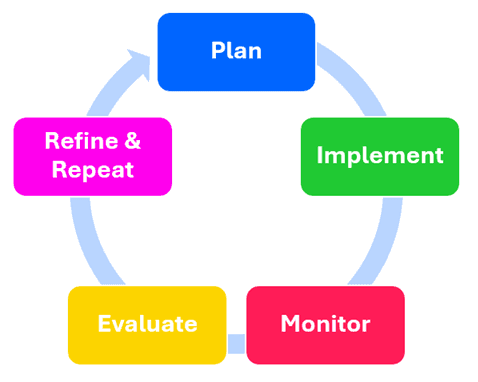
The Continuous Quality Improvement Cycle
The Office of Head Start describes continuous improvement as an ongoing process of measuring performance, identifying areas of concern, making timely corrections, and using those insights to strengthen the entire program.
Continuous Quality Improvement is most effective when it becomes part of a repeatable process rather than a one-time initiative.
Most successful Head Start agencies follow a simple cycle: | |
|---|---|
 |
|
Continuous Quality Improvement is not about achieving perfection—it's about making steady, measurable improvements over time.
GoEngage supports every stage of this cycle through real-time dashboards, reporting, AIR Notes, Application Quality Reviews, Staff Collaboration, Coaching Caseload, and automated workflows that help agencies turn insights into action.
📥 Free Download: Head Start Continuous Quality Improvement (CQI) Planning Worksheet
Building a culture of Continuous Quality Improvement starts with having a consistent process for identifying opportunities, developing action plans, and following up on progress. While the concepts of CQI are straightforward, documenting those efforts consistently can be challenging—especially when multiple departments and staff members are involved.
To help agencies put these principles into practice, we've created a Head Start Continuous Quality Improvement (CQI) Planning Worksheet.
Whether you're an Executive Director, Program Director, Education Manager, ERSEA Manager, Family Services Manager, Health Manager, or anyone responsible for program quality, this worksheet provides a structured framework for documenting and managing Continuous Quality Improvement efforts throughout the year.
The worksheet helps leadership teams:
Identify strengths and opportunities for improvement
Analyze root causes of recurring issues
Develop measurable improvement goals
Assign action items and accountability
Document staff coaching and follow-up
Evaluate progress over time
Prepare for federal monitoring and self-assessments
Celebrate successes and recognize staff achievements
Whether you're preparing for federal monitoring, conducting ongoing monitoring, reviewing program data, or leading your annual self-assessment, this worksheet provides a practical framework for documenting Continuous Quality Improvement efforts across your agency.
Continuous Quality Improvement isn't a destination—it's an ongoing commitment to learning, improving, and delivering the highest-quality services possible.
The following frequently asked questions address some of the most common topics agencies ask about Continuous Quality Improvement.
Frequently Asked Questions About Continuous Quality Improvement (CQI) in Head Start
What is Continuous Quality Improvement (CQI) in Head Start?
Continuous Quality Improvement (CQI) is an ongoing process of evaluating program performance, identifying opportunities for improvement, implementing changes, and measuring results. In Head Start, CQI helps agencies use data to strengthen compliance, improve service delivery, support staff development, and achieve better outcomes for children and families. Rather than being a one-time initiative, CQI is a continuous cycle of planning, monitoring, evaluating, and improving.
Is Continuous Quality Improvement required in Head Start?
Yes. The Head Start Program Performance Standards require agencies to implement a process of ongoing monitoring and continuous improvement. These requirements help programs ensure they are meeting federal regulations, achieving program goals, and providing high-quality services to children and families. Continuous Quality Improvement is a core component of effective program management—not simply a best practice.
What is the difference between ongoing monitoring and Continuous Quality Improvement?
Ongoing monitoring is the process of regularly reviewing program operations, data, and performance throughout the year to identify strengths and areas needing attention. Continuous Quality Improvement builds on that information by using it to make informed decisions, improve processes, coach staff, and measure progress over time. In simple terms: - Ongoing Monitoring identifies what is happening. - Continuous Quality Improvement focuses on what to do about it. Together, they help agencies create a culture of continuous learning and improvement.
Why is staff coaching important for Continuous Quality Improvement?
Continuous Quality Improvement isn't about finding mistakes—it's about helping staff succeed. When supervisors review applications, files, or documentation, coaching conversations help staff understand what was missed, why it matters, and how to improve in the future. This approach builds confidence, increases consistency, and reduces recurring errors over time. A culture of coaching creates stronger teams and supports long-term program quality.
How does data support Continuous Quality Improvement?
Data provides agencies with the information they need to make informed decisions rather than relying on assumptions. By reviewing reports and monitoring trends throughout the year, agencies can: - Identify compliance risks early - Measure progress toward program goals - Improve data accuracy - Allocate resources more effectively - Provide targeted coaching and training - Strengthen overall program performance Using data proactively helps agencies address concerns before they become larger issues.
How can technology support Continuous Quality Improvement?
Technology helps agencies move from reactive problem-solving to proactive program management. Instead of waiting until monitoring season to identify concerns, modern software can provide real-time visibility into program performance through dashboards, automated alerts, standardized workflows, reporting, and collaboration tools. These capabilities help staff work more consistently while giving leadership the information needed to support continuous improvement.
How does GoEngage support Continuous Quality Improvement?
GoEngage was designed to help Head Start agencies build quality into their everyday operations—not just during monitoring reviews. With tools like real-time dashboards, application quality review workflows, Staff Collaboration, automated alerts, and comprehensive reporting, GoEngage helps agencies: - Monitor program performance throughout the year - Improve data quality and compliance - Support coaching and professional development - Identify trends before they become larger issues - Make informed, data-driven decisions - Strengthen services for children and families By combining technology with best practices, GoEngage helps agencies create a sustainable culture of Continuous Quality Improvement.
How can agencies build a culture of Continuous Quality Improvement?
Building a culture of Continuous Quality Improvement starts with making quality part of everyday work—not just annual reviews or federal monitoring. Successful agencies focus on: - Establishing standardized processes - Using data to guide decisions - Providing ongoing coaching and professional development - Encouraging collaboration across departments - Monitoring progress throughout the year - Celebrating improvements and learning from challenges When quality becomes everyone's responsibility, agencies are better positioned to improve compliance, support staff, and deliver exceptional services to children and families.
Who should be involved in Continuous Quality Improvement?
Continuous Quality Improvement is most effective when it involves staff across the organization. Executive Directors, Program Directors, Education Managers, ERSEA Managers, Family Services Managers, Health Managers, teachers, family advocates, and support staff all play an important role in identifying opportunities, implementing improvements, and measuring progress. Creating a culture of quality means making improvement everyone's responsibility.
Final Thoughts
Continuous Quality Improvement isn't about doing more work—it's about doing better work.
When agencies combine thoughtful processes, meaningful coaching, data-informed decision-making, and technology that supports staff, they build a culture where improvement becomes sustainable.
At GoEngage, we believe software should do more than help agencies maintain compliance—it should help them continuously improve. By providing real-time visibility, standardized workflows, collaborative coaching tools, and actionable reporting, GoEngage empowers agencies to strengthen operations, support staff, and ultimately deliver better outcomes for children and families.
Every small improvement today creates a stronger program tomorrow. At GoEngage, we're committed to helping agencies build sustainable systems that empower staff, strengthen compliance, and improve outcomes for every child and family they serve.
Office of Head Start Resources
To learn more about Continuous Quality Improvement in Head Start, explore these Office of Head Start resources:
Ready to Strengthen Continuous Quality Improvement at Your Agency?
GoEngage helps Head Start agencies build quality into everyday operations through real-time dashboards, application quality reviews, Staff Collaboration, automated alerts, and powerful reporting.
Whether you're preparing for federal monitoring or looking to strengthen everyday processes, we're here to help.